The safest thing on your street is a neighbour who would say something
A safer street isn't only about policing or crime rates. Research shows that trust, neighbour involvement and collective efficacy can shape how communities respond to problems and how safe neighbourhoods feel.
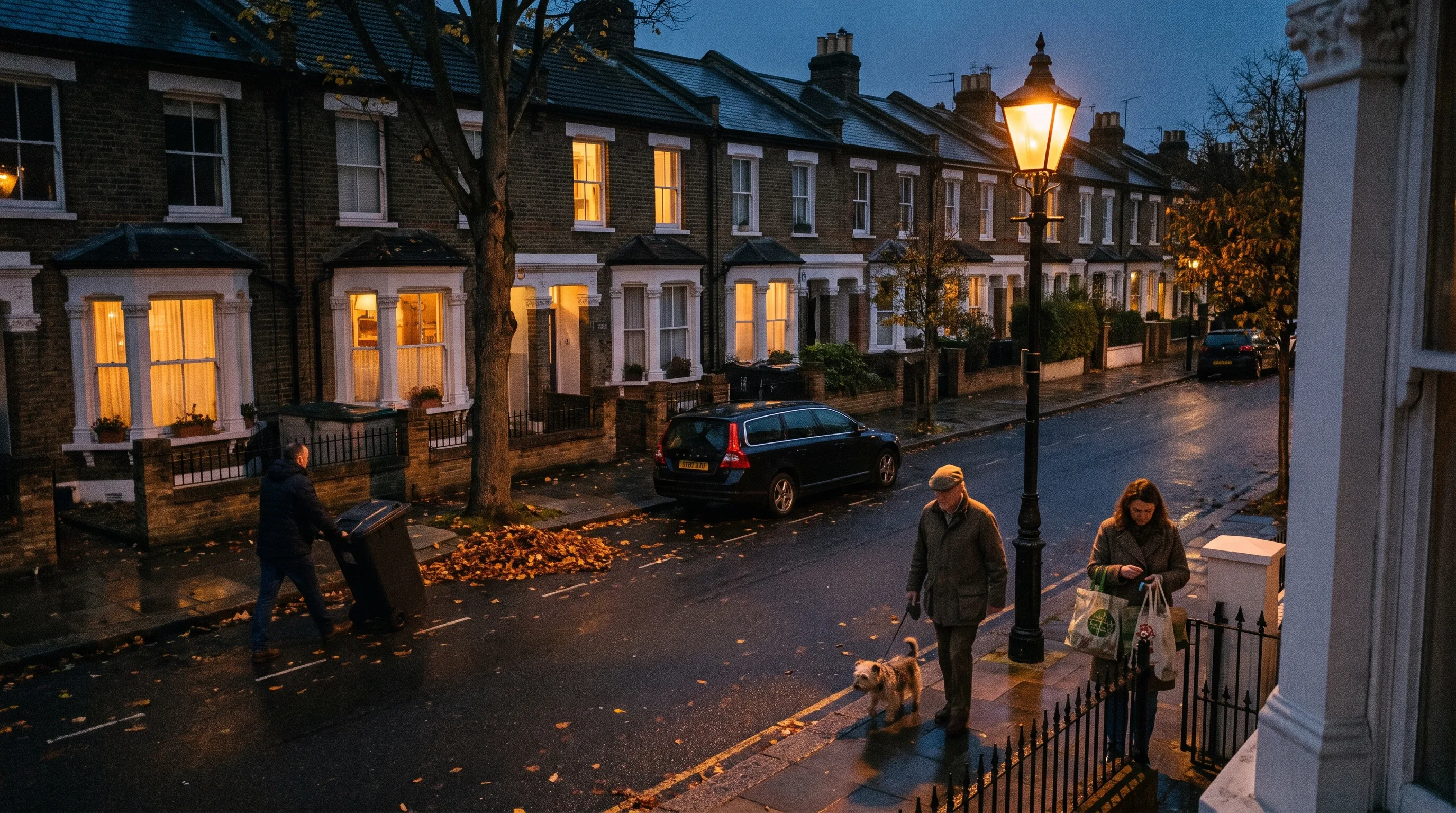
On collective efficacy, vividness bias, and the loop we are trying to break
In 1995, a team of researchers led by Robert Sampson interviewed 8,782 people across 343 neighbourhoods in Chicago. They were trying to answer a question that sounds simple and turns out not to be. Why do two areas with similar poverty, similar housing and similar demographics end up with very different levels of violence?
The answer they published in Science in 1997 has shaped how criminologists think about neighbourhoods ever since. The strongest predictor was not policing levels, not CCTV, not even deprivation on its own. It was something they named collective efficacy: "social cohesion among neighbours combined with their willingness to intervene on behalf of the common good".
Neighbourhoods with high collective efficacy had less violence. More than that, the effects of deprivation and of people moving in and out constantly were largely mediated by collective efficacy. Disadvantage didn't produce violence directly. It produced violence partly by eroding the sense that anyone here would do anything.
It is not about being friends with your neighbours

This is the part that gets lost, and it matters enormously for anyone trying to build something useful.
Collective efficacy is not neighbourliness. It is not a street party, or a WhatsApp group, or knowing everyone's name. Sampson's measure was built around expectation. How likely is it that people around here would step in, if children were skipping school, if someone was spray-painting a wall, if a fight broke out? Later work describes the core of it as "people's perceptions of the likelihood their neighbours would intervene to solve neighbourhood problems".
You do not need to like your neighbours. You need to believe they would do something. And critically, they need to believe the same about you.
That is a belief about other people. Which means it is vulnerable to anything that distorts what we believe about other people.
Enter the vividness problem
In 1973, Amos Tversky and Daniel Kahneman described what they called the availability heuristic. When people judge how likely or how common something is, they don't retrieve statistics. They retrieve examples. And whatever comes to mind most easily gets treated as most probable.
Retrievability, though, is not driven by frequency. It is driven by vividness, recency and emotional charge. A stabbing you saw on the news three days ago is retrievable. Four thousand uneventful nights on your road are not retrievable at all, because nothing happened, so nothing was encoded, so nothing comes back.
George Gerbner spent decades documenting the consequence at scale. His cultivation research found that heavy consumers of television, a medium that massively over-represents crime relative to real life, were more likely to see the world as dangerous and other people as untrustworthy. He called it mean world syndrome.
You can watch this happen in current British data. Ipsos asked people who believed crime had risen why they believed it. 78% pointed to things they had seen on the news.
Meanwhile the King's College London Policy Institute found the public's median guess for how many people are victims of crime in a year was 27%, against a reality of 9.7%. We are not estimating. We are recalling, and then reporting the recall as if it were an estimate.
The loop
Put those two ideas together and you get something worse than either.
Vividness bias inflates your sense of risk. Inflated risk makes you withdraw. You don't linger, you drive rather than walk, you cross the road, you keep the door shut. In February 2026, YouGov found 71% of women had changed their route to avoid walking in the dark in the darker months.
Withdrawal is rational at the individual level and corrosive at the street level. A street with fewer people on it has fewer eyes on it, fewer casual encounters, and less of the low-grade familiarity that collective efficacy is built from.
And collective efficacy is what was holding the actual risk down.
So fear that isn't proportionate to risk produces behaviour that reduces the thing which was suppressing risk. The fear becomes, slowly, more justified. Not because the news was right, but because everybody believed it and went inside.
The British numbers are worth looking at honestly, because they are mixed rather than uniformly bleak. In England, the share of people who say many people in their neighbourhood can be trusted has fallen to 38%, from 40% the year before, the first real movement after several stable years. The share who feel they belong strongly to their immediate neighbourhood slipped to 61%, from 62%. But the share who say people in their neighbourhood pull together to improve it rose five points to 61%, recovering some ground, though still below the 65% recorded in 2020/21.
Read that carefully and it says something quite specific. Willingness to act is holding up. Trust in the people you'd be acting alongside is not. Given that collective efficacy needs both, that is the more worrying half to be losing.
Where we are careful
We would be doing the same thing we're criticising if we overstated the science, so here are three honest caveats.
Collective efficacy is not a cure-all. A study of Greater Manchester published in the British Journal of Criminology found that measures of social disorganisation and collective efficacy had only a limited effect on a neighbourhood's exposure to crime once concentrated disadvantage was accounted for. The Chicago findings do not transplant automatically to a London borough.
The construct itself is debated. Researchers disagree about whether social cohesion and willingness to intervene should be measured as one thing or two, and the relationship between them varies by context.
And "informal social control" has a dark version. A critique that runs through the literature asks whether informal social control is simply policing by another name. A street where everyone is watching everyone can slide into a street where a particular sort of person gets watched. That is not a hypothetical risk for a product like ours. It is the single most likely way we could do harm, and we would rather say so out loud than discover it later.
What we are actually trying to build
Glome exists because of the loop, not because of the crime rate.
Two things break that loop, and both pull in the opposite direction from the way information currently reaches you.
The first is base rates. The antidote to a vivid story is not a reassuring story. It is a denominator. If we can tell you what a normal week on your street actually looks like, most weeks that means telling you almost nothing happened. That is a strange thing for an app to do, and it is the most important thing we do. The good kind of quiet only works as information if someone is counting it.
The second is legible presence. Collective efficacy runs on the belief that other people here would act. You cannot hold that belief about people you have no evidence exist. So the point of confirming that real people live on a real street is not security theatre. It is making the denominator of neighbours as visible as the numerator of incidents. A street where you can see that twenty-three people nearby have confirmed they live here is a different psychological object from a street where you can see only the last thing that went wrong.
That is the whole vision, and it is deliberately unglamorous. Not to make you safer by making you more afraid. To close the gap between how safe your street is and how safe it feels, and in closing it, to rebuild a little of the thing that was keeping it safe in the first place.
References
1: Sampson, R.J., Raudenbush, S.W. and Earls, F. (1997) 'Neighborhoods and Violent Crime: A Multilevel Study of Collective Efficacy', Science, 277(5328), pp. 918-924. https://doi.org/10.1126/science.277.5328.918
2: Yesberg, J.A. and Bradford, B. (2021) 'Policing and collective efficacy: A rapid evidence assessment', International Journal of Police Science and Management. https://journals.sagepub.com/doi/full/10.1177/14613557211026938
3: Tversky, A. and Kahneman, D. (1973) 'Availability: A heuristic for judging frequency and probability', Cognitive Psychology, 5(2), pp. 207-232. See also Tversky, A. and Kahneman, D. (1974) 'Judgment under Uncertainty: Heuristics and Biases', Science, 185(4157), pp. 1124-1131. https://doi.org/10.1126/science.185.4157.1124
4: Gerbner, G. et al. (1980) 'The "Mainstreaming" of America: Violence Profile No. 11', Journal of Communication, 30(3), pp. 10-29. For an overview of cultivation theory and the Mean World Index, see https://www.simplypsychology.org/cultivation-theory.html
5: Ipsos (2025) Majority of Britons think crime is a big problem, with 6 in 10 believing it has risen over the past year. November 2025. https://www.ipsos.com/en-uk/majority-of-britons-think-crime-is-a-big-problem-6-in-10-believe-it-has-risen-over-the-past-year
6: The Policy Institute, King's College London (2026) Wrongful convictions? Misperceptions about crime among the UK public, 17 August 2026. YouGov, 1,797 UK adults (2,164 for the victimisation question), fieldwork 23 to 27 March 2026. https://www.kcl.ac.uk/news/public-perceptions-of-crime-at-odds-with-reality-study-finds
7: YouGov for Active Travel England (2026). 2,125 UK adults aged 18+, fieldwork 17 to 18 February 2026. https://activetravelengland.gov.uk/news/nationwide-plans-announced-design-safer-streets-9-10-women-report-feeling-unsafe-walking-night
8: Department for Digital, Culture, Media and Sport (2026) Community and Engagement Survey 2025/26: neighbourhood and community report, published 14 August 2026. Representative of people aged 16 and over in England; the community questions were asked between October 2025 and March 2026. Note that the report's key findings section describes the fall in neighbourhood trust as three percentage points while its detailed section describes it as two. We quote the two levels (40% to 38%) rather than the change. https://www.gov.uk/government/statistics/community-and-engagement-survey-202526-neighbourhood/community-and-engagement-survey-202526-neighbourhood-and-community-report
9: Inequality in Exposure to Crime, Social Disorganization and Collective Efficacy: Evidence from Greater Manchester, United Kingdom, The British Journal of Criminology, 62(4), pp. 1019-1043. https://academic.oup.com/bjc/article/62/4/1019/6430049