Neighbourhood Watch had it right in 1982. It just never got a smartphone.
Neighbourhood Watch has helped communities prevent crime for decades. Here’s what made it work, why its traditional model is struggling, and what a modern digital version could rebuild.
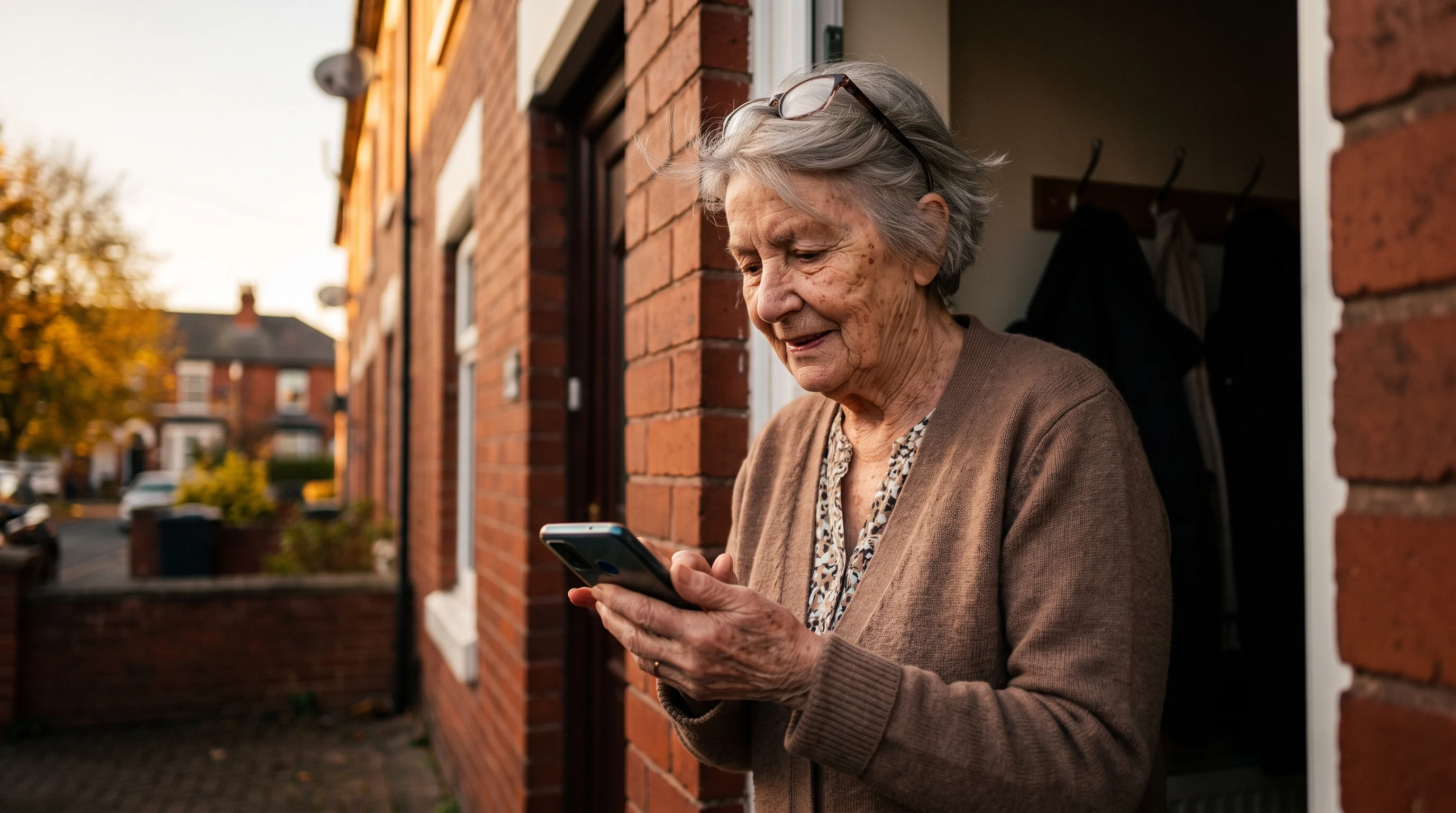
In 1982, a village near Chester had a run of burglaries. A local crime prevention officer, Sergeant Grahame Andrews, set up a scheme in response and called it Homewatch. Mollington, Cheshire, population somewhere in the hundreds, became the first Neighbourhood Watch in the United Kingdom.
It spread with remarkable speed. Through the 1980s and into the early 1990s, Neighbourhood Watch went from one village to a national movement. Today it remains the largest crime prevention voluntary movement in England and Wales: 2.3 million members, over 90,000 coordinators running schemes, and more than 65,000 active volunteers.
We get asked fairly often whether Glome is "just Neighbourhood Watch on a phone". The honest answer is yes, more or less, and we think that is a compliment. But the interesting part isn't the resemblance. It's the specific set of things Neighbourhood Watch got right forty years ago, and the specific set of constraints it was built inside that no longer apply.
It actually worked
This deserves saying clearly, because "does Neighbourhood Watch do anything?" gets treated as an open question far more often than the evidence warrants.
In 2008, Trevor Bennett, Katy Holloway and David Farrington published a systematic review for the Campbell Collaboration, the gold-standard method for pooling evidence across studies. Their narrative review covered 19 studies and 43 evaluations. The meta-analysis covered 12 studies and 18 evaluations. The conclusion: Neighbourhood Watch was associated with a reduction in crime of between 16% and 26%.
That is a serious effect size for an intervention whose core technology is a sticker in a window and people talking to each other.
It also lines up with the theory. As we've written about elsewhere, the strongest neighbourhood-level predictor of violence that criminologists have found is collective efficacy, meaning social cohesion combined with a willingness to intervene for the common good. Neighbourhood Watch is, in effect, a deliberate attempt to manufacture collective efficacy. It doesn't catch criminals. It changes what residents expect of one another, and it advertises that change to everyone, including the person considering the back window.
The constraints it was built inside
Here is what Neighbourhood Watch had to work with in 1982.
Communication was a printed newsletter, a phone tree, and a person who knocked on doors. Membership meant a household on a coordinator's list. The unit of organisation was a street where people had lived for years and expected to live for years more. Verification, the question of whether you really live where you say you live, didn't need solving, because the coordinator knew you by sight.
Every one of those has changed. Private renting has grown enormously, and with it the rate at which households turn over. People work hours that don't align with the neighbours. The person who might once have been a coordinator is now commuting, caring, or working a second job. And the effort of maintaining a scheme falls, almost always, on one volunteer, which means the scheme is exactly as durable as that person's circumstances.
The research bears this out. A recent study of Neighbourhood Watch's contemporary position found that senior roles have historically been held by people in their 50s, 60s and 70s, with a marked lack of participation from younger generations. Stakeholders across the movement identified age as the most frequently raised concern about membership. Notably, the same research found that where Neighbourhood Watch groups are vibrant, they tend to have younger, more diverse members, and that the picture is beginning to shift, particularly as cybercrime becomes more salient and social media becomes a way of connecting.
That is not a story about a bad idea. It is a story about a good idea whose delivery mechanism aged.
What has to be rebuilt, not just digitised
The temptation is to take Neighbourhood Watch and put it in an app. A feed, a group chat, notifications. Several products have tried this. It mostly produces something closer to a local Facebook group: high volume, low signal, and dominated by whoever posts most.
The bit that made Neighbourhood Watch work wasn't the communication. It was that everyone on the list was a real person who really lived there, and everyone knew it. That is the property a group chat loses immediately and quietly. Once you can't tell who is a neighbour, who is three miles away, and who joined to advertise a driveway service, the reports stop meaning anything. And a report that doesn't mean anything is worse than no report at all, because it still frightens people.
So the thing to rebuild first is not the feed. It is the coordinator's knowledge that you live here.
That is why Glome asks people to confirm their home, including, deliberately, by posting a code to the address. It is slow, it costs us money, and it is the only method that proves the thing we actually need proved. It is why a confirmed resident can vouch for the other adults in their household, so a five-person house needs one card rather than five. And it is why what you see on your street is limited to what people who live on your street have said.
The rest of the design follows from things Neighbourhood Watch already understood. Small units, because a street is a thing people feel loyalty to and a borough isn't. Low drama, because a scheme that cries wolf gets ignored. And a bias towards nothing happened as a legitimate thing to report, because most weeks on most streets the accurate message is that it was quiet, and a system which can only speak when something is wrong will systematically misinform you.
What a phone cannot do, and what we could get wrong
Two honest limits.
A phone cannot knock on a door. The most valuable thing that happens in a functioning Neighbourhood Watch is that a person notices an elderly neighbour hasn't drawn the curtains and goes to check. No notification substitutes for that. What software can do is lower the cost of the first contact, and make it likelier that you know who lives at number 42 before the day you need to. It cannot do the going round.
And we inherit Neighbourhood Watch's failure modes along with its strengths. A scheme built on residents watching for what looks out of place can, without anyone intending it, become a scheme where a particular kind of person always looks out of place. That risk is real, it is documented, and digitising it would scale it. We design against it deliberately: no photographs of people, no descriptions of individuals, categories rather than speculation, and reports tied to accountable residents rather than anonymous accounts. We would rather have fewer reports than build a product that makes a street less welcoming than it was.
The same idea, forty years on

Neighbourhood Watch's own new strategy, running from 2026 to 2030, sets out an ambition to create "flourishing communities where neighbours look out for each other". We'd sign that sentence without changing a word.
We are not trying to replace 2.3 million people and 90,000 coordinators, several of whom, we suspect, will be among our most useful early users. We are trying to rebuild the conditions those schemes depended on, for streets where the newsletter and the phone tree and the person who knocks no longer exist.
Same theory. Same unit. Different century.
References
1: Neighbourhood Watch Network, Our journey; and Wikipedia, Neighbourhood Watch (United Kingdom). The first UK scheme was established in Mollington, Cheshire in 1982 by Sgt Grahame John Andrews under the name Homewatch, following a series of local burglaries. https://ourwatch.org.uk/our-journey and https://en.wikipedia.org/wiki/Neighbourhood_Watch_(United_Kingdom)
2: Neighbourhood Watch Network, Neighbourhood Watch today and Neighbourhood Watch unveils bold new strategy (2026 to 2030). https://www.ourwatch.org.uk/about-us/who-we-are/neighbourhood-watch-today and https://www.ourwatch.org.uk/news/neighbourhood-watch-unveils-bold-new-strategy
3: Bennett, T., Holloway, K. and Farrington, D. (2008) 'The Effectiveness of Neighborhood Watch', Campbell Systematic Reviews, 4(1). Weighted mean odds ratio 1.19 (fixed effects) to 1.36 (random effects), indicating a crime reduction of approximately 16% to 26%. https://onlinelibrary.wiley.com/doi/full/10.4073/csr.2008.18
4: Sampson, R.J., Raudenbush, S.W. and Earls, F. (1997) 'Neighborhoods and Violent Crime: A Multilevel Study of Collective Efficacy', Science, 277(5328), pp. 918-924. https://doi.org/10.1126/science.277.5328.918
5: "The community supporting the community … that's where its strength is": exploring the contemporary position of Neighbourhood Watch in the United Kingdom, Safer Communities, 24(2), pp. 116-130. https://www.emerald.com/sc/article/24/2/116/1245270/The-community-supporting-the-community-that-s